
Container Gardens
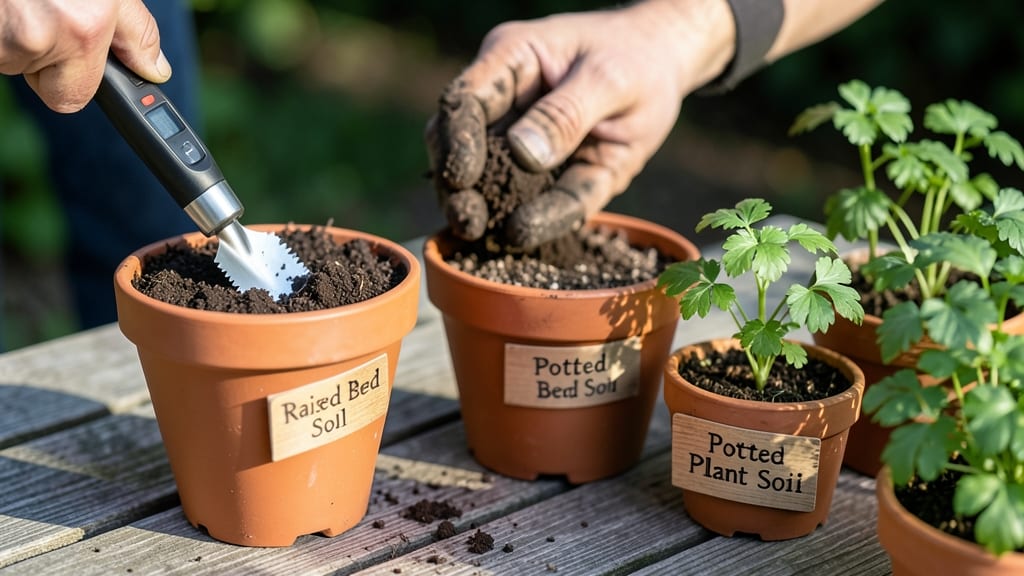
You can use raised bed soil in pots, but it needs modifications—it compacts easily and drains poorly, so blend it with perlite or compost (1:1 ratio) to boost aeration and fertility. Heavy clay soils should never be used directly in containers, as they'll suffocate plant roots.
Raised bed soil works best in pots when you transform its texture and structure. 🌱 The dense composition that makes it ideal for in-ground gardens becomes a liability in containers, where roots need both air and water movement.
I've found that adding coarse sand or coconut coir (20-30% by volume) prevents compaction while maintaining moisture retention. For plants like herbs or lettuce, this mix performs well, but avoid it for succulents—they need gritty, fast-draining blends instead.
Another key factor is organic matter. Raised bed soil often lacks the microbial diversity of potting mixes, so I recommend adding well-rotted compost (about 10% of the total mix) to jumpstart nutrient availability.
This approach mimics the looser, more fertile conditions plants thrive in when grown in containers. Always test your soil's drainage first—if water pools after 15 minutes, you need more perlite or vermiculite.
💡 In This Article
- Why Raised Bed Soil Fails in Pots Without Modifications
- Best Ways to Repurpose Raised Bed Soil for Container Gardening
Why raised bed soil fails in pots without modifications
Raised bed soil is engineered for in-ground gardens where roots can spread freely and excess water drains gradually into surrounding soil. In containers, however, the confined space creates a completely different environment.
The compacted texture of raised bed soil blocks oxygen flow to roots, a critical issue since roots need air for respiration—just like we do. Without proper aeration, roots suffocate, leading to stunted growth or even death within 2-4 weeks in extreme cases.
The problem worsens with moisture retention. Raised bed soil tends to hold water like a sponge, creating anaerobic conditions (low oxygen) that promote root rot. Unlike potting mixes designed with 30-50% pore space for drainage, raised bed soil often has less than 10% air pockets.
This means water pools at the bottom of pots, drowning roots instead of nourishing them. For example, a 5-gallon pot filled with unmodified raised bed soil can stay waterlogged for days after a single watering.
Another hidden issue is nutrient availability. Raised bed soil relies on slow-release organic matter from surrounding plant debris, but in containers, this process speeds up dramatically due to higher microbial activity. Within 4-6 weeks, essential nutrients like nitrogen and phosphorus deplete faster than in-ground soil.
This is why container plants often show yellowing leaves or weak stems—even with regular fertilization—when grown in unamended raised bed soil.
Consider the texture comparison: potting mixes have a light, crumbly structure similar to cake batter, while raised bed soil feels dense like packed sand. This compactness restricts root expansion, forcing roots to grow in tight circles rather than spreading outward.
For instance, a tomato plant in unmodified raised bed soil may produce 30-50% fewer fruits compared to one in a proper potting mix, due to this restricted growth pattern.
The science behind this involves soil physics. Raised bed soil has a higher bulk density (weight per volume) than ideal potting mixes, meaning it's heavier and more resistant to root penetration.
When you squeeze a handful, you'll notice it holds together tightly—this is the same property that chokes roots in containers. Even plants with shallow root systems, like basil or lettuce, struggle because their fine root hairs can't access nutrients efficiently in this dense medium.
One final factor is heat retention. Raised bed soil absorbs and radiates heat more intensely than potting mixes, which can raise root zone temperatures to 90°F+ on sunny days. While some plants tolerate this, most container crops prefer cooler root zones (65-75°F).
This heat stress further reduces plant vigor, creating a perfect storm of poor drainage, nutrient depletion, and thermal shock that explains why raised bed soil fails in pots without modifications.