
How To
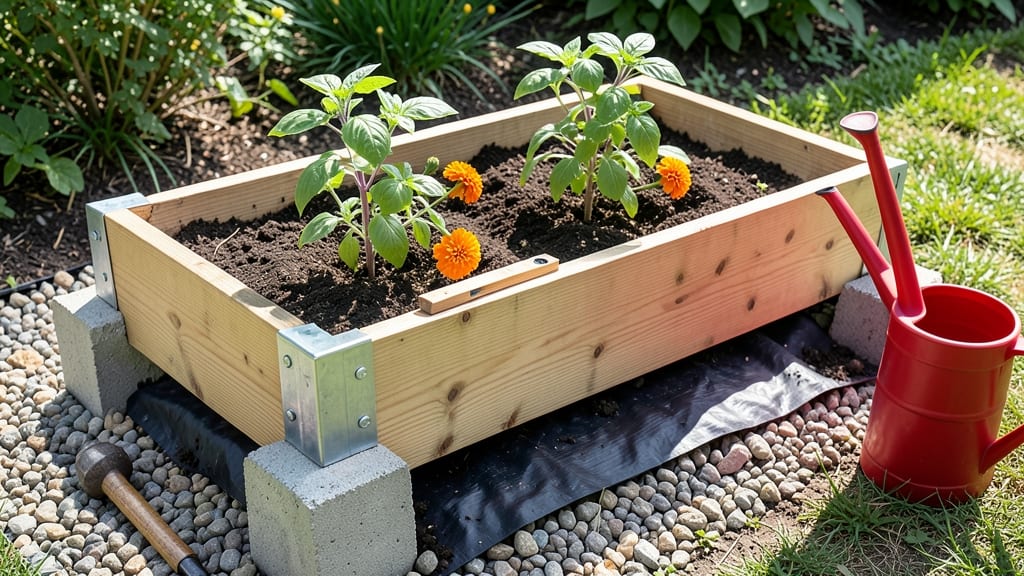
You can put a raised garden bed on concrete, but only with lightweight designs (under 50 lbs per square foot) and proper support like leveling pads or a solid base to avoid cracking or instability over time.
Concrete slabs are rigid and unforgiving, which means they can't absorb the weight or movement of a heavy garden bed. 🔥 Without proper support, the pressure causes concrete to crack or the bed to shift unevenly—especially when soil freezes and expands in winter.
I recommend using composite lumber or metal frames (both under 50 lbs/sq ft) and adding gravel bases or adjustable feet to distribute weight evenly. This approach keeps your plants stable while protecting your concrete investment.
For extra protection, consider concrete leveling pads under the bed's corners. These distribute weight and prevent direct contact between the bed and slab. 💫 Always check your concrete's load-bearing capacity first—older or thinner slabs may need additional reinforcement. When in doubt, consult a structural engineer to ensure safety and longevity.
💡 In This Article
- How Concrete Affects Raised Garden Bed Stability
- Best Lightweight Materials and Support Solutions for Concrete Surfaces
How concrete affects raised garden bed stability
Concrete slabs are rigid and have zero give, which creates a major challenge for raised garden beds. When soil freezes in winter, it expands with force—up to 9% by volume—and this pressure gets transferred directly to the concrete below.
Since concrete has almost zero flexibility, that expansion force can cause micro-cracks to form over time, especially at the slab's edges. 🔥 The problem worsens with heavier beds because the concentrated weight increases the risk of uneven settling or even structural failure in older slabs.
Thermal expansion plays another critical role. Concrete expands when heated by sunlight (up to 0.0006 inches per inch per degree Fahrenheit) and contracts when cooled. If your garden bed isn't properly supported, this constant movement can cause the frame to shift or the soil to compress unevenly.
Imagine placing a 200-pound wooden frame on a concrete surface—without proper leveling, even a slight temperature change could create gaps where plants might lean or roots could dry out.
The real danger lies in how weight distributes. A standard 4'x8' cedar bed filled with soil weighs about 1,200 pounds—that's roughly 37.5 lbs per square foot. While this seems manageable, concrete slabs are designed for static loads (like driveways), not dynamic ones from shifting soil.
The pressure points at the bed's corners become high-risk areas where cracks often initiate. This is why most structural engineers recommend keeping garden bed weights under 50 lbs per square foot on concrete.
Another hidden factor is moisture. Concrete absorbs water, and when soil freezes, the resulting ice crystals can push against the slab's surface. Over multiple freeze-thaw cycles, this creates internal stress that weakens the concrete's integrity. The result?
You might notice hairline cracks appearing near where your garden bed sits—cracks that could widen over time and require costly repairs. 💫 This is why proper drainage and support systems are non-negotiable when placing beds on concrete.
For visual context, think of concrete like a frozen lake: it looks solid, but beneath the surface, hidden stresses build up.
A garden bed acts like a boat on that lake—without proper flotation (in this case, leveling pads or a gravel base), it will eventually sink or crack the ice below. The key is distributing that weight across multiple contact points rather than letting it concentrate in a few spots.
What most people overlook is how these forces compound over time. A bed that feels stable in summer might develop issues in winter when soil expands. The concrete's inability to flex means those seasonal changes become permanent structural challenges.
This is why professionals recommend using adjustable feet or leveling pads—they create a buffer zone that absorbs some of that movement while keeping your plants growing straight.