
Advice
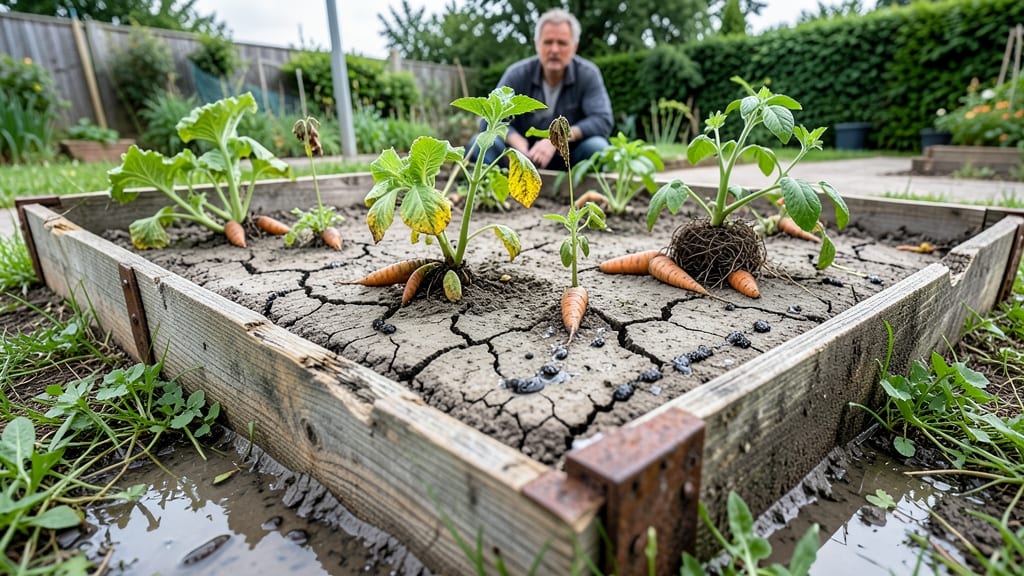
The disadvantages of raised bed gardening include higher upfront costs for materials, faster soil drying that demands more frequent watering, and restricted root space that limits deep-rooted plants. You'll also face increased weed pressure along bed edges and potential mobility challenges when moving heavy structures.
While raised beds offer many benefits, their limitations become clear once you factor in long-term expenses like replacing weathered wood or hardware cloth. 🔥 The soil dries out faster than in-ground plots, forcing you to water more often—especially in hot climates—while shallow root zones can stunt crops like sweet potatoes or fruit trees.
Even the edges become battlegrounds for weeds, and lifting a full bed for repositioning turns into a back-breaking task when they're heavy with soil. For beginners, these trade-offs might outweigh the convenience of raised beds unless you're willing to invest extra time and resources.
Some gardeners also discover that nutrient depletion happens quicker in contained soil, requiring more frequent amendments like compost or fertilizer. The good news? These challenges can be mitigated with proper planning—choosing lightweight materials, installing irrigation systems, and selecting plant varieties that thrive in confined spaces.
But for those with limited mobility or deep-rooted crops in mind, the drawbacks often make in-ground gardening the more practical option.
💡 In This Article
- Cost and Maintenance Drawbacks of Raised Garden Beds
- Plant and Soil Limitations in Raised Beds
Cost and maintenance drawbacks of raised garden beds
Building a raised bed isn't just about the initial purchase of lumber or composite materials—it's an investment that extends far beyond the first season. High-quality cedar or redwood planks can cost $50-$100 per bed, while hardware cloth for pest protection adds another $20-$50.
The soil itself isn't cheap either: a 4'x8' bed filled to 12" depth requires about 1.5 cubic yards of premium garden mix, which typically runs $3-$6 per cubic foot—that's $1,620-$3,240 per bed just for soil alone. 💰
The maintenance costs don't stop there. Wood beds degrade over time—cedar lasts 7-10 years, while untreated lumber may need replacement in just 2-3 years due to rot and termites.
Soil compaction and nutrient depletion mean you'll need to top-dress with 2-4 inches of compost annually, adding $50-$150 per year to your budget.
In arid climates, you might also face 30-50% more water usage than in-ground gardens, with some gardeners reporting water bills increasing by $20-$50 per month during peak growing seasons.
What's often overlooked is the labor cost of maintenance. Refilling a bed with fresh soil every 3-5 years requires heavy lifting—moving 1-2 tons of soil isn't a weekend project.
The edges of raised beds become weed magnets because sunlight hits them directly while the center stays shaded, forcing you to pull weeds from the edges 2-3 times more frequently than in-ground plots.
Even "lightweight" beds filled with soil can weigh 500-1,000 pounds, making repositioning nearly impossible without mechanical help.
Climate plays a surprising role in these costs. In hot, dry regions, raised beds can lose moisture 3-5 times faster than ground soil, demanding daily watering during summer months.
Some gardeners install drip irrigation systems ($100-$300 per bed) just to keep up, while others resort to mulching with straw or wood chips (adding $50-$150 annually). In colder climates, the soil freezes deeper in raised beds, requiring extra insulation like thick mulch or even heated mats during early spring planting.
For renters or those with limited budgets, these costs become dealbreakers. A single 4'x8' bed can represent $1,500-$3,500 in total 5-year costs when factoring materials, soil, and maintenance.
Compare that to in-ground gardening, where the only recurring expense is compost ($20-$50 per year) and occasional tilling ($50-$100 every few years). The convenience of raised beds comes at a premium that many gardeners underestimate until they're knee-deep in soil replacements and water bills.
Here's what most people don't realize: the "savings" from not tilling every year get offset by the hidden costs of soil replenishment and material degradation.
A 6'x12' in-ground plot might cost $0 upfront (just your labor for digging) but requires $100-$200 annually in compost and occasional soil amendments—still far less than a raised bed's long-term expenses.
For small spaces, the math often works out better to stick with in-ground gardening unless you're willing to treat raised beds as a semi-permanent (and expensive) fixture.